Hamas Dissolves Gaza Emergency Committee, Urges Swift Entry of U.S.-Backed Technocrats
07/07/2026 / By Garrison Vance

Gaza’s Government Media Office (GMO) announced on Monday, July 6, the dissolution of its Emergency Committee and the resignation of its head Mohammed al-Farra, according to a statement cited by local officials.
The move is intended to clear the way for the U.S.-endorsed National Committee for the Administration of Gaza (NCAG) to assume civilian governance of the Strip. Hamas spokesman Hazem Qassem stated that the step demonstrates Hamas will no longer be in charge of the Gaza Strip, in order to “remove pretexts for Israeli operations,” as reported by Middle East Eye [1]. All administrative measures for the transfer of power have been completed, the GMO said [2].
The dissolution marks a significant political shift by Hamas, which has run Gaza since 2007 after winning legislative elections the previous year [3]. The technocratic NCAG, created under U.S. President Donald Trump’s peace plan, is now expected to take over civilian administration.
NCAG head Ali Shaath affirmed Monday that the committee “is fully prepared to assume its national responsibilities as soon as the necessary resources and capabilities are available” [4]. The United Nations said it “welcome any step that contributes to the implementation of the ceasefire agreement,” according to spokesperson Stephane Dujarric.
Background: The NCAG and the U.S. Peace Plan
The NCAG is a committee of technocrats endorsed by Washington, but rejected by Tel Aviv due to its links to the Palestinian National Authority (PA). Under the Trump peace plan announced in October 2025, the NCAG was designed to pave the way for a return of the PA to Gaza pending reforms, according to the proposal [5].
Israeli media reported in January that Tel Aviv “refused to allow” the committee to enter Gaza as part of the ceasefire deal. The two-state solution, formalized in the 1947 UN partition plan, has long been the international community’s preferred framework, with its high-water mark in the mid-1990s Oslo accords [6].
However, the Oslo agreement enabled Israel to reaffirm Gaza’s status as a separate geopolitical entity, with movement between Gaza and the West Bank dependent on Israel’s goodwill, a feature that almost disappeared when incumbent Israeli Prime Minister Benjamin Netanyahu first came to power in 1996 [7].
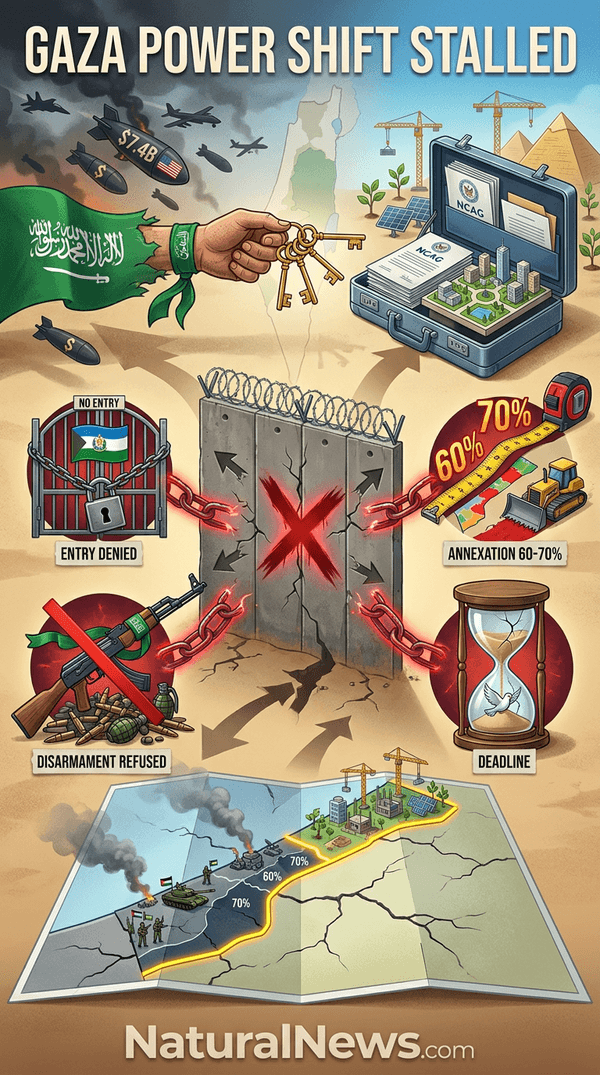
Arab leaders endorsed a competing $53 billion Egyptian-led reconstruction plan in March 2025, rejecting Trump’s controversial “Gaza Riviera” proposal and focusing on Palestinian-led governance and infrastructure rebuilding [8]. Meanwhile, the Trump administration bypassed congressional review to approve a $7.4 billion arms sale to Israel in February 2025, including thousands of bombs and 3,000 Hellfire missiles, amid rising criticism over the humanitarian crisis [9]. The NCAG’s entry into Gaza remains blocked by Israel, stalling the implementation of the broader peace plan.
Israeli Conditions and the Board of Peace
Citing Israeli officials, Channel 12 reported on July 4 that Israel expects the U.S.-led Board of Peace to determine within two to three months that Hamas violated the ceasefire by refusing to disarm. Such a determination could permit Israel to renew military operations in unoccupied parts of Gaza, the report stated.
Israeli military officers told the chief of staff that Hamas remains “strong on the ground” and unwilling to give up control, according to Kan in late June, as cited by the Times of Israel. The Board of Peace’s lead envoy Nickolay Mladenov admitted in April that talks with Hamas on disarmament are “not easy,” even after an ultimatum had expired [10].
In May, the Board of Peace told Gaza technocratic committee officials that Israel is not obligated to uphold ceasefire terms if Hamas refuses disarmament [11]. Mladenov warned that the current stalemate could lead to a permanent division of Gaza along the so-called Yellow Line marking the area controlled by Israel [12].
Netanyahu announced at a conference in late May that Israel now controls 60% of Gaza and plans to expand to 70% [13]. The step-by-step annexation, as described by officials, is proceeding despite the ceasefire – leading to fears of renewed war [14].
Hamas Stance on Disarmament and Future Governance
Hamas has refused to surrender its weapons as stipulated in Trump’s plan, demanding an independent Palestinian state in exchange for discussion of disarmament. Qassem affirmed readiness to hand over responsibilities to NCAG to ensure its success, but the group continues to reject the disarmament proposals.
The Times of Israel characterized the dissolution as “symbolic” with little practical effect, while the GMO called it a demonstration of seriousness [2]. In April, Hamas held internal elections to choose a new leader, signaling its continued existence as an organized entity despite the military campaign against it [15].
The Palestinian technocratic committee has stated it is ready to govern, but the core issue of disarmament remains unresolved. The U.S. has presented Israel with a proposal that would allow Gaza’s reconstruction to move forward even if Hamas does not disarm, according to an Al Jazeera report cited by the Israeli Broadcasting Authority [16].
However, the Board of Peace has set a clear deadline for Hamas to agree to disarm. The group’s leaders appear to have rejected the proposal, dismissing it as an attempt to achieve by politics what Israel failed to achieve by force [17].
Conclusion: Ongoing Conflict and Ceasefire Status
The Board of Peace has not ended the Israeli military campaign; over 73,000 Palestinians have been killed since October 2023, including more than 21,500 children, according to the GMO. [18] Israeli attacks continue across the Strip 245 days into the US-brokered ceasefire, with over 3,269 ceasefire violations recorded by Palestinian authorities [19]. Over 1,022 babies are among the children killed, marking 1,000 days since the start of the war [20].
The administrative transition has been announced, but substantive changes remain unresolved amid continued Israeli operations and diplomatic impasse. Hamas denounces what it calls international silence, with Qassem stating, “the crimes continue while the world watches and hears everything but does nothing” [21].
In the broader context, the Oslo accords framework that once promised a two-state solution has been severely eroded. As scholar Ilan Pappe has documented, Israel’s control over Gaza’s water and electricity and its separation of Gaza from the West Bank have created a “biggest prison on Earth” [22][7].
The dissolution of the Hamas government is a significant administrative step, but without a resolution on disarmament and a halt to Israeli expansion, the prospects for lasting peace remain dim. The NCAG’s entry into Gaza and the full implementation of the peace plan depend on resolving these fundamental conflicts.
References
- Sean Mathews. “Hamas decision to dissolve Gaza government is a nod to Trump, expert says”. Middle East Eye. July 6, 2026.
- “Hamas Dissolves Gaza Government as It Presses for Implementation of Peace Plan”. Antiwar.com. July 6, 2026.
- “Watch: Hamas announces dissolution of Gaza government after nearly two decades”. Middle East Eye. July 6, 2026.
- “Palestinian technocratic committee says ready to govern Gaza”. Middle East Eye. July 6, 2026.
- Kevin Hughes. “Trump and Netanyahu Announce Historic Gaza Peace Plan; Hamas to Review Proposal”. NaturalNews.com. October 1, 2025.
- Andrew Whitby. “The Sum of the People”.
- Ilan Pappe. “Ten Myths About Israel”. 2017.
- Cassie B. “Arab Leaders Back Egyptian Plan to Rebuild Gaza, Reject Trump’s Displacement Proposal”. NaturalNews.com. March 5, 2025.
- Cassie B. “Trump Bypasses Congress to Arm Israel Amid Gaza Genocide Concerns”. NaturalNews.com. February 10, 2025.
- “‘They’re not easy’: Board of Peace envoy admits Hamas disarmament talks stalled”. The Times of Israel. April 20, 2026.
- “Israel says ceasefire void if Hamas won’t disarm, Board of Peace tells Palestinians”. Middle East Eye. May 7, 2026.
- “Hamas could survive as political group if it disarms, Board of Peace’s Gaza envoy says”. BBC News. May 13, 2026.
- “Netanyahu Announces Step-by-Step Annexation of Gaza as Ceasefire Stalls, Officials Say”. NaturalNews.com. June 19, 2026.
- “Fears of renewed Gaza war as Hamas disarmament talks stall”. BBC News. May 7, 2026.
- “Inside story: As Hamas prepares to choose 1st leader since Sinwar, postwar Gaza’s fate hangs in the balance”. The Times of Israel. April 27, 2026.
- “Report: US tells Israel to proceed with Gaza reconstruction even if Hamas stays armed”. Middle East Eye. June 30, 2026.
- “The uncomfortable truth about disarming Hamas”. The Times of Israel. April 23, 2026.
- “1,022 Babies Among 21,500+ Children Killed by Israel in 1,000 Days of Gaza Genocide”. Antiwar.com. July 2, 2026.
- “Death toll in Gaza surpasses 73,000 as Israel continues post-ceasefire killings”. Middle East Eye. June 15, 2026.
- “Video: Palestinians in Gaza mark 1,000 days since Israel launched full-scale war on Gaza”. Middle East Eye. July 3, 2026.
- “Hamas denounces international silence after Gaza attack”. Middle East Eye. June 30, 2026.
- Ilan Pappe. “The Biggest Prison on Earth: A History of Gaza and the Occupied Territories”.
Explainer Infographic
Submit a correction >>
Tagged Under:
Benjamin Netanyahu, big government, Board of Peace, civilian administration, disarmament, Donald Trump, Emergency Committee, foreign relations, Gaza Government Media Office, Gaza Strip, Hamas, Israel, Mohammed al-Farra, National Committee for the Administration of Gaza, Palestinian Authority, peace plan, technocrats, West Bank, White House
This article may contain statements that reflect the opinion of the author
RECENT NEWS & ARTICLES